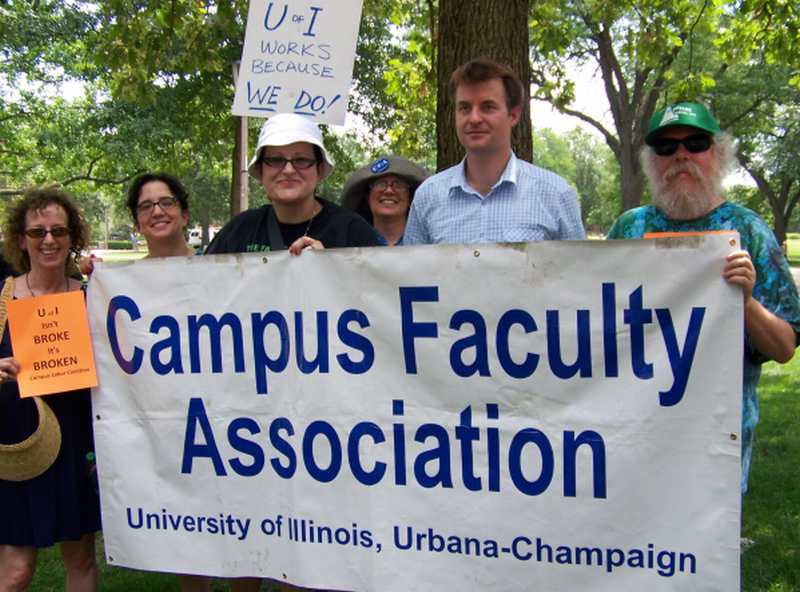
CFA Resolutions on Protecting Benefits

The below resolutions were passed by the CFA Executive Committee on May 21, 2013.

1. The Campus Faculty Association opposes the Cullerton and Madigan pension bills (SB2404, SB 1, respectively), and affirms the constitutionally protected right for all Illinois state employees and retirees to receive their full pension benefits. If either bill becomes law, the CFA supports litigation to challenge the constitutionality of the law.

2. The Campus Faculty Association opposes the recent legislation that will charge long-term state retirees for their health insurance. This legislation breaks the long-standing promise of free health insurance after twenty-years service, and proportional coverage for other long-term employees. The CFA supports the court challenge to this legislation by the Illinois State Employees Association and others, Maag v. Quinn, Sangamon Co. Case No. 2012-L-162.

People Are Corporations, My Friend

The below Letter to the Editor by the CFA’s Bruce Reznick was published here on May 21, 2013 in the online version of the Chicago Tribune.

So Illinois is in such dire financial shape that it must violate the contractual retirement agreements with teachers and other state workers. I’ve taught at the University of Illinois since 1979 and am one of those who would be cheated by the bills under discussion in the legislature.

Why stop there? The crisis should require every company with a state contract get paid 20 percent less, and every company with a state concession should pay 20 percent more. I’m looking at you, casinos. This is an emergency!

We all know such actions are unrealistic and near impossible. Companies make business decisions based on signed contracts. You can’t change them after commitments have been made.

Well, people are corporations too, my friend. People are corporations too.

Bruce Reznick, Urbana

Our Weekly Reader for the Week of 5/5/2013

A grim financial week for faculty and staff. You’ve probably seen the news on the passage of a pension bill in the Illinois House. There is some commentary from Capitol Fax here, here, and here. There are further reactions at the Illinois Issues Blog, Progress Illinois which cites the We Are One Coalition response, and Robert Rich.
     Senate President John Cullerton is said to have worked with unions on crafting a pensions bill (as yet unrevealed) but no version was called in the House, and it’s unclear whether the current bill of House Speaker Michael Madigan will be called in the Senate.  So the fate of our pensions depends on the outcome of opaque backroom macho posturing.  Forget it Jake, it’s Illinois.
     In other cheerful news, health costs for current and retired UI employees are going way up. See more about the announcement here and here.
     Overall, the week’s news presents a damning indictment of the impotent failure of those who claim to have been officially representing our interests.

Today’s Academic Senate Meeting: Our Take

April 29, 2013

Today in the last meeting of the year of the Academic Senate, it was announced that the Senate Executive Committee might meet over the summer to examine wages, benefits and working conditions.

We in the CFA have spent the past two years talking with our colleagues about  salaries, benefits, working conditions. Clearly our efforts have attracted the attention of the central administration, which has finally taken serious notice of these concerns. However, our discussions have also revealed that the vast majority of faculty voices are not usually part of the top-down policy-formulating and decision making process.  This newly announced and vaguely constituted committee may or may not come up with recommendations; it is a very small step.

The CFA wants to emphasize that only a legally binding collective bargaining agreement can effectively and fairly resolve salary disparities, improve retirement benefits and family leave policies, guarantee a fair and transparent grievance process, and address many of the other issues that affect the faculty.  We also point out that anything granted by administrative fiat can also be taken away.  Collective bargaining is the best path to protect and enhance working conditions here at UIUC.

For further information please check out this website or email us at campusfacultyassoc@gmail.com.

Visioning Future Excellence: First Reactions

We at Campus Faculty Association are still studying Chancellor Wise and Provost Adesida’s announcements at the Town Hall meeting on Monday.  We are pleased to see recognition of some of the pressing concerns we have been hearing in our face-to-face conversations all around campus, but we have reservations about some of the planned actions, and whether they will meet campus needs.

Our first take is that the plan to hire new faculty is a step in the right direction, but insufficient. The plan sounds dramatic (“hire 500 new faculty”), but the full announcement is much less satisfactory, and will achieve no more than replacing the faculty numbers lost in the past few years. Over the last five years, tenure track faculty numbers have fallen by about 10%, while student numbers have risen by about the same percentage.   The Visioning Future Excellence plan aims to replace these lost faculty over roughly the next seven years, while also adding back those lost to normal attrition. This is how they reach the headline number of 500 hires, by including replacement faculty hires.  By 2020, faculty numbers should be back where they were in 2007 – yet with thousands more students to teach than in that year.

While this is an important start, it is not enough to strengthen and preserve research and teaching excellence at our university. The surge in retirements and departures over the last few years was caused in large part by the threat of further damage to our retirement benefits, and by frozen and lagging salaries.  We still face those threats, and our own central administration has announced that it supports a permanent 2% pay cut in the form of an increased employee contribution to SURS.  The administration has also endorsed a reduction of the cost of living adjustment for future retirees.  Until these major problems are solved, UIUC will face continued erosion of the tenure-stream faculty.    A union with collective bargaining rights would help faculty to address pension issues at the campus and state levels, and would work with the University to preserve excellence over the long term.

Our Weekly Reader for the Week of 4/21/2013

During a challenging week, there were two stories of special note. First, President Easter testified before the State Legislature on Friday morning and you should read everything he said. Pension reform, Easter stated, is “important to us being able to have a stable financial platform and to be able to recruit and retain faculty and staff.”

Second, in a noteworthy implementation of shared governance, the faculty at Amhest College rejected, by direct vote, participation in the MOOC EdX.

Signing a Mission Statement vs. A Union Card

The Campus Faculty Association Organizing Committee has been talking with colleagues  about campus issues and collective bargaining. We’d like to address some questions regarding what a signature on our Mission Statement means, and what it does not mean.

1. Is the mission statement the same as a union authorization card?

NO. A union card is unmistakable―when you see one, you’ll know it! The Mission Statement is quite different―it is a non-binding show of support for the principles in the document, including collective bargaining for faculty at UIUC. Signing  the Mission Statement indicates a likelihood of supporting a union if an election is held later, but it does not mean the signer has voted in a card check election now.

A union card, to be valid under Illinois law, needs to meet certain legal requirements. It must include a statement that authorizes the named organization “to be the exclusive bargaining representative.” This language is not on the CFA Mission Statement but is present when there is a union card check campaign underway. The union cards are then filed with the Illinois Education Labor Relations Board to be validated and counted in an election, while the Mission Statement is a sign of support for the CFA’s principles and for collective bargaining.

2. Is there a union card drive on campus right now?

NO. There is no card drive election going on. We are talking with colleagues across the university about campus issues and collective bargaining, but this is not the same as a card drive election.

3. How did faculty at UIC vote for the union?

Faculty led the campaign at UIC. The card check election at UIC was an open, democratic process―faculty organizers, assisted by staff, collected cards authorizing UIC United Faculty/AFT/IFT/AAUP as the certified bargaining agents for the faculty as whole. The union cards met all the strict legal requirements. Some faculty opposed forming a faculty union but an absolute majority of all faculty eligible for membership in the collective bargaining unit signed the cards. In fact, the faculty at UIC voted twice for a faculty union. In 2012, they brought back a second, larger majority of cards after the administration challenged the first vote.

Please contact us by email if you would like more information on CFA and collective bargaining.

CFA Responds to President Easter’s Pension Proposal

We are glad to see President Easter and other university leaders throughout Illinois addressing the crisis in the state’s unfunded liabilities and the threat this poses to the pensions state employees have contributed to and planned on throughout their careers. As with other changes in state finances and their impact on the university, the proposals once again underscore the need for collective bargaining.

The proposal to increase employee contributions amounts to an immediate, permanent two percent pay cut at a time when faculty salaries at Illinois are already lagging behind peers. It also represents a permanent reduction in guaranteed retirement income, since the proposed change to the COLA limits and delays cost of living increases. An average salary increase of about four per cent would be required to offset this additional cost and the effects of inflation.

The plan also proposes to shift the pension burden to the University over time. Given the current and projected levels of state funding and the state’s inability to come up with even those funds, this is likely to add greater financial stress in the coming years. The university will either have to catch up on the quality of salaries and benefits, or suffer a further decline in its status.

The move from a defined benefit to a hybrid system would expose more recent Tier Two colleagues to market volatility, raising the possibility of continued problems for those basing retirement plans on this much less secure system.

Our most serious concern, however, has less to do with the details of this proposal than with the decision-making involved. As far as we are aware, President Easter arrived at his decision to support this plan without consulting the various campus senates, our senate benefits committee, or other shared governance bodies. The plan will now roll ahead without input from faculty or from other campus workers. Clearly, as it stands now the administration can make decisions about our current situation and even our futures without the consent of the faculty. The need for genuine consultation on such vital issues is one reason we need a union.

For those who might object that the problem is in Springfield and not in Urbana, this is another argument for and not against unionization. Legally, our academic senate cannot lobby on this or other issues even if it chose to do so. A powerful faculty union lobbying in concert with teachers and other public employee unions throughout the state would provide us a greater voice in Springfield to fight for better funding of the university and higher education generally. Without such representation, our futures will continue to be determined by others.

Jim Barrett, CFA President

(President Easter’s April 9, 2013 announcement was by mass mail; see also http://www.niutoday.info/2013/04/09/public-university-leaders-endorse-pension-plan)

Here’s a link to UIC’s United Faculty statement on pensions:

https://iftweb.ift-aft.org/6456/home/uic-uf-statement-on-pensions